Fez is a city that operates on a rhythm untouched by centuries. At its heart, beneath the piercing call to prayer echoing across the riad rooftops, lies the ancient medina—a labyrinth of over nine thousand narrow alleys where donkeys still carry heavy loads of raw hides and brassware. Among the most iconic sights in this UNESCO World Heritage site are the leather tanneries, sprawling open-air dye pits that have functioned continuously since medieval times. For any traveler with a camera, capturing this vibrant spectacle is a high priority. Yet, photographing a working industrial heartland where real people make their daily livelihood requires a delicate balance of technical know-how and deep cultural respect.
Understanding the Landscape: Navigating the Tanneries
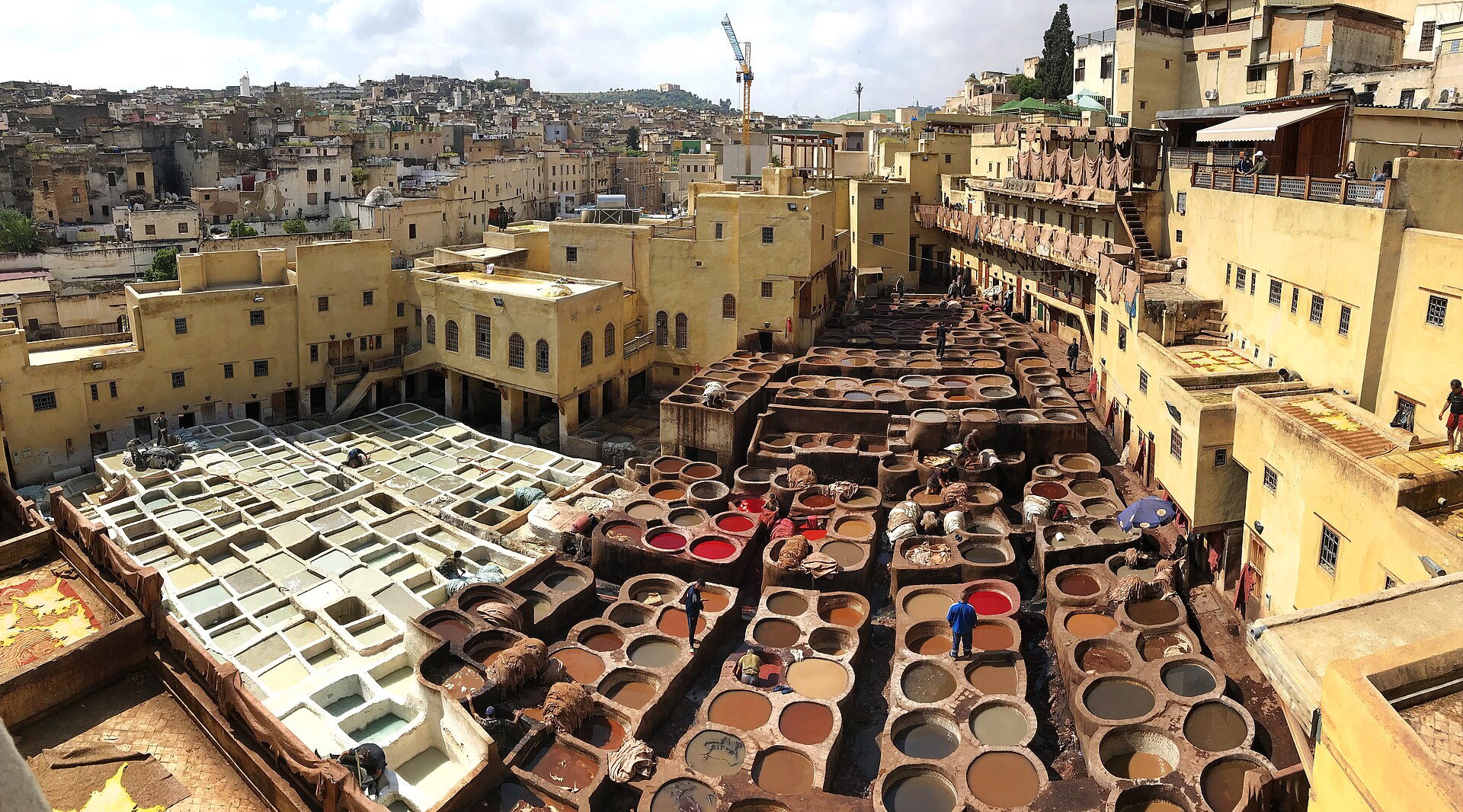
Fez actually houses several tanneries, but the largest and most visually arresting is Chouara Tannery, situated near the Andalusian quarter at the end of Derb Tsebbine. Operating since the 11th century, it is a hive of intense physical labor where artisans stand waist-deep in stone vessels filled with whitewash, pigeon droppings, and natural dyes ranging from poppy to indigo.
To photograph Chouara effectively, you need to gain elevation. The tannery is entirely surrounded by leather shops and terraces that double as viewing platforms. The distance from the main entrance of the medina (Bab Bou Jeloud) to Chouara is roughly a 20-minute walk through the winding arteries of Fes el-Bali. Because GPS signals fail inside the medina’s stone canyons, hiring an official local guide for your first visit is invaluable. They will not only keep you from getting lost but will also navigate the complex social etiquette of the terraces.
Mastering the Shot: Lenses, Light, and Perspectives
When you step onto a viewing terrace, the visual impact is immediate: a patchwork of honeycombed stone vats filled with colorful liquids, surrounded by hides drying in the harsh North African sun. To capture this dynamic scene, your gear choices matter.
A standard zoom lens, such as a 24-70mm, is essential for capturing the sweeping, high-angle vista of the entire complex. However, the true magic lies in the details—the lined, weathered hands of an artisan hauling a heavy skin, or the fine spray of water caught in the midday sun. For these intimate portraits, a telephoto lens or a fast 50mm prime allows you to isolate subjects without intruding on their workspace.
Timing is critical. The optimal time to shoot is mid-morning, roughly between 9:00 AM and 11:00 AM, when the sun clears the surrounding walls and illuminates the vats directly, without casting harsh, deep shadows. Avoid the midday glare when the light becomes brutally flat, and steer clear of late afternoon when the pits fall into shadow. As you enter the shops leading to the terraces, staff will traditionally hand you a fresh sprig of mint to hold under your nose to combat the pungent, ammonia-rich odor of the curing process. It is a polite gesture; accept it graciously before lifting your camera.
Ethics Behind the Lens: Respecting Local Livelihoods
It is vital to remember that the tanneries of Fez are not a theme park created for tourists; they are a grueling, traditional workplace. The men working down in the vats are laborers earning a modest living under extremely demanding physical conditions.
Always ask for explicit permission before taking close-up portraits of individual artisans. A simple “Min fadlik” (please) accompanied by a gesture toward your camera usually suffices. If an artisan declines, lower your camera immediately with a polite smile and a nod of acknowledgment. Never use long lenses to covertly snap workers from a distance as if they were exhibits in a zoo.
When viewing from the shop terraces, it is customary to offer a small tip—typically 20 to 50 MAD (roughly 2 to 5 EUR)—to the shopkeeper who grants you access. While many shopkeepers will try to guide you toward purchasing leather goods afterward, you are under no obligation to buy. A polite, firm refusal accompanied by a generous tip for the view is entirely acceptable and respects the local mercantile culture.
To experience the authentic depth of Fez beyond the surface and gain seamless access to its working artisan quarters with knowledgeable local experts, consider exploring the city through a tailored private tour with Morocco Moment Tours.