For decades, the mention of the Moroccan Sahara conjures images of the towering golden erg dunes of Erg Chebbi near Merzouga or the vast, remote expanses of Erg Chigaga out of M’hamid El Ghizlane. These oceans of sand are magnificent, but they have also become the default tracks for mass tourism. If you venture slightly off the beaten path, past the crowded tourist tent settlements and roaring quad bikes, an entirely different desert emerges. Here, ancient nomadic trails intersect with secluded Berber hamlets, prehistoric rock art, and fossil-rich plateaus that remain untouched by the tour bus circuit.
The M’harech Oasis and the Dakar Rally Tracks
Leaving the paved roads behind as you travel west from the Tafilalet towards the Algerian border, the landscape flattens into an austere, mesmerizing hamada—a stony desert plateau. About 70 kilometers northwest of Merzouga lies the remote oasis of Ouzina and further out, the legendary outpost of M’harech. This route shadows the historic tracks of the Paris-Dakar Rally, winding through sun-baked riverbeds and dramatic black volcanic mountains.
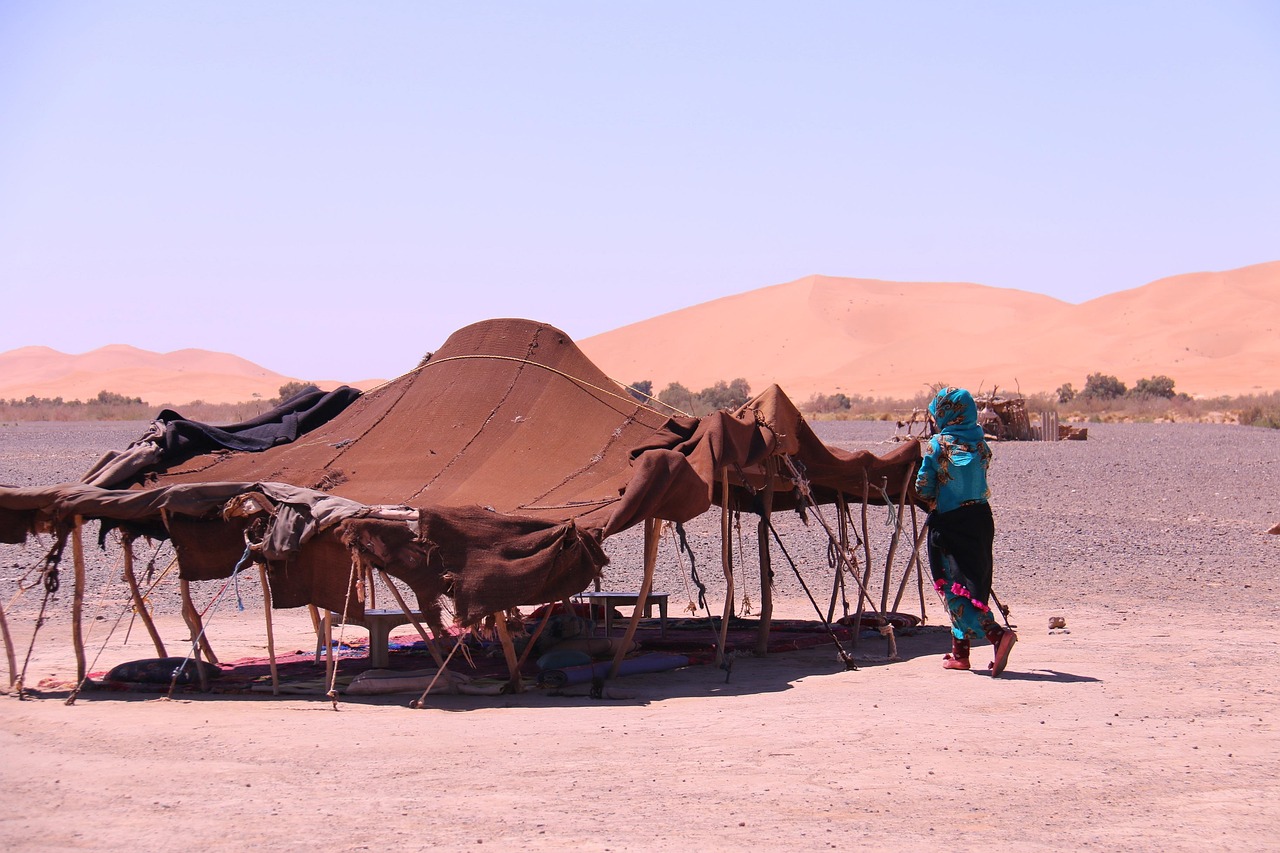
Accommodations here are deeply authentic, consisting of modest, family-run guesthouses or intimate desert camps built from local mud-brick and palm wood rather than luxury canvas. Staying in M’harech offers a profound silence that is increasingly difficult to find near Erg Chebbi. You dine on slow-cooked lamb madfouna—the Berber version of a stuffed pizza—prepared in a subterranean earth oven by your hosts, whose lineage traces back to nomadic desert crossers. Reaching this area requires a 4x4 vehicle; a standard rental car will not survive the corrugated piste tracks. Expect a private 4x4 transfer from Erfoud to cost between 1,200 MAD and 1,800 MAD (approx. 110–165 EUR) depending on the vehicle and driver.
The Prehistoric Engravings of Foum Zguid and Erg Ghoul
Further south, near the gateway town of Foum Zguid, the desert transitions into the dried bed of Lake Iriki, a surreal expanse of cracked white clay framed by the jagged peaks of Jebel Bani. While many travelers simply cross Iriki on their way to Chigaga, the surrounding region holds secrets that date back millennia. Hidden within the rocky outcrops of Azrou Kleb are some of North Africa’s most significant yet least-visited prehistoric rock engravings.
Dating back over 9,000 years to a time when the Sahara was a lush savannah, these sites feature remarkably preserved carvings of elephants, giraffes, and rhinos. Exploring these petroglyphs requires a local guide from the nomadic Ait Atta tribes, who knows the precise folds in the terrain where the carvings are hidden. Nearby, secluded desert camps near Erg Ghoul offer a raw, uncommercialized wilderness experience. A guided day excursion from Foum Zguid to explore these remote rock art sites and remote dunes typically ranges from 800 MAD to 1,200 MAD (approx. 75–110 EUR) for a dedicated local guide and 4x4.
The Hidden Valley of the Draa: Beyond the Tourist Trail
While the upper Draa Valley between Agdz and Zagora is famous for its dense palm groves and kasbahs, the lesser-known lateral valleys cutting into the Jebel Bani offer a glimpse into traditional Berber agricultural life untouched by modern tourism. Villages like Tazzarine and Nkob serve as jumping-off points for deep desert treks into landscapes dominated by jagged red-rock mesas that resemble the American Southwest.
In these villages, centuries-old fortified granaries, known as agadirs, stand sentinel over terraced barley fields and date palm plantations. Unlike the restored tourist kasbahs of Skoura, structures here like the ruined kasbahs of Oussaif are wild and melancholic. Independent travelers can hire local mountain guides in Nkob for day hikes starting at around 300 MAD to 500 MAD (approx. 30–45 EUR). These walks wind through hidden gorges, connecting remote hamlets where Berber is the primary language spoken, and Arabic or French are secondary.
Honest Practical Advice for Venturing Off-Piste
Venturing beyond Chegaga and Chebbi demands careful preparation. This is a remote frontier region where cellular network coverage is patchy at best and nonexistent in the deep dunes.
First, never attempt to drive unpaved desert tracks in a standard two-wheel-drive vehicle. The shifting sands, sharp shale, and washboard pistes require a robust 4x4 and a driver experienced in deflation techniques and desert navigation. Always carry a minimum of five liters of drinking water per person per day, alongside basic mechanical recovery gear if you are self-driving—though self-driving the deep south without an experienced local guide is strongly discouraged.
When visiting remote Berber communities, cultural sensitivity is paramount. Always ask permission before photographing locals, particularly women and elders. Tipping local guides and drivers is customary and deeply appreciated; a standard guideline is 100 to 150 MAD per day for a driver and 50 to 100 MAD for a local site guide. Finally, respect the fragile ecosystem by minimizing plastic waste, as remote desert communities lack municipal waste management infrastructure.
To experience these undiscovered Berber sites and remote Sahara camps with the comfort, safety, and local insight of a tailored itinerary, Morocco Moment Tours designs bespoke private journeys departing directly from Fes.