Stepping out of the administrative quiet of Rabat and heading down the Atlantic highway toward Casablanca feels like shifting gears from Morocco’s political past to its high-octane economic present. It is roughly an 85-kilometer journey down the A1 motorway, a straight shot that takes about an hour by train or slightly longer by car, depending on how aggressively Casablanca traffic greets you at the city limits. For travelers based in the capital with an extra day to spare, the temptation to bridge these two coastal hubs is strong. But does the drive actually deliver on its promise, or is Casablanca just an industrial giant best left to the business travelers?
The Logistics: Train Versus Road
If you decide to make the journey, the first decision is how to move between the cities. The Al Boraq high-speed rail is not an option here—that line currently skips Rabat when running north-south—but the standard ONCF trains run with impressive frequency. A second-class ticket on the shuttle train costs roughly 40 to 50 MAD (about 4 to 5 EUR), and the ride from Rabat-Ville station to Casa-Port takes just under an hour. It is clean, reliable, and deposits you right on the edge of the old medina and a short walk from the central districts.
Driving, on the other hand, gives you flexibility but tests your patience. Car rentals are easy to secure in Rabat, and highway tolls will run you around 25 MAD each way. The real challenge begins once you exit the motorway and enter Casablanca’s grand boulevards. Traffic is notoriously assertive, parking is a competitive sport, and navigating the Art Deco grid requires a steady hand. Unless you plan on stopping at coastal suburbs like Mohammedia along the way, the train remains the sensible choice for a day trip.
The Architectural Divide: Hassan II Mosque and the Mauresque Legacy
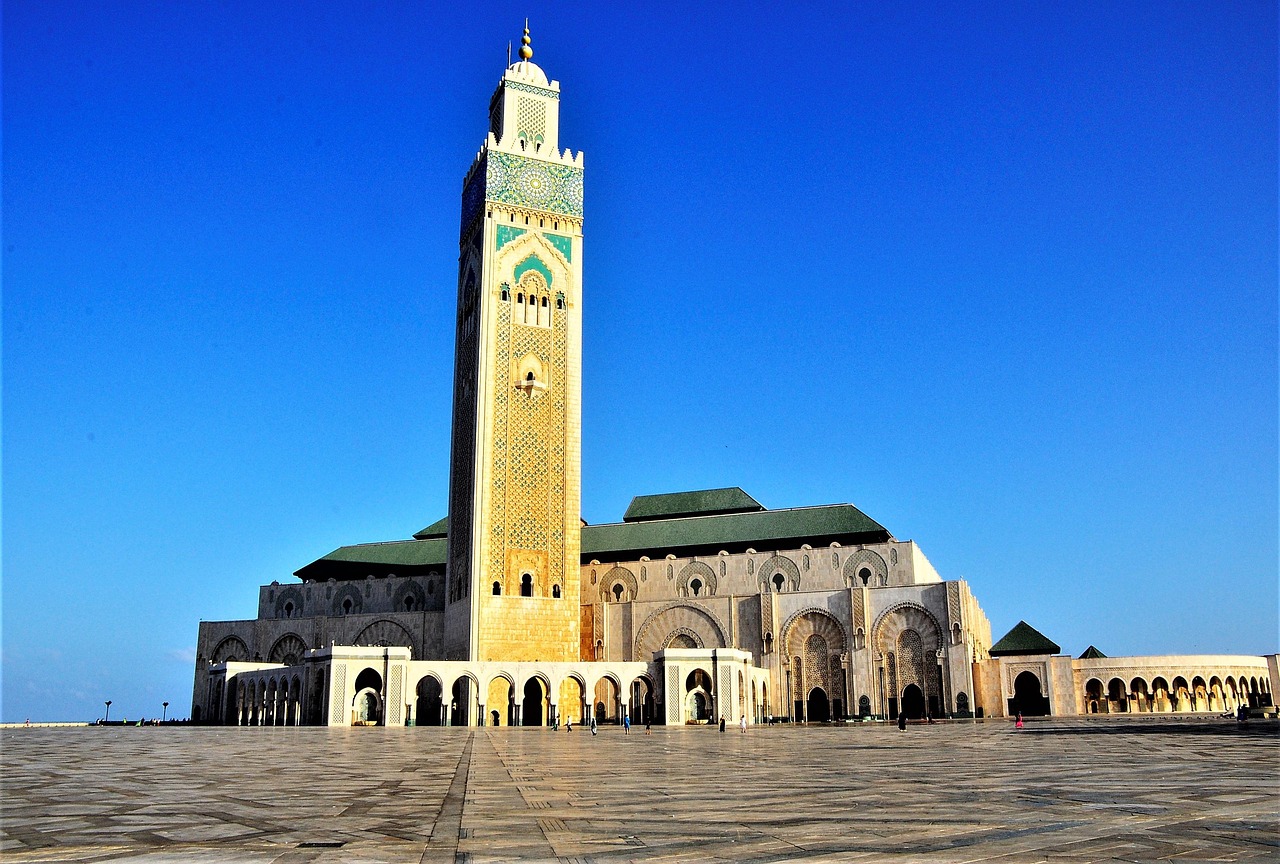
You cannot talk about Casablanca without talking about the Hassan II Mosque. Standing dramatically on a rocky outcrop over the Atlantic Ocean, its minaret pierces the sky at 210 meters, making it one of the tallest religious structures in the world. Non-Muslims can visit the interior through guided tours, which run multiple times a day. Tickets cost 130 MAD (around 12 EUR), and the sheer scale of the craftsmanship—hand-carved stuc, massive cedar wood ceilings, and acres of intricate zellij tilework executed by thousands of master artisans—justifies the hype. It is a masterpiece of modern Islamic architecture that honors traditional Moroccan design.
From there, drift inland toward Place Mohammed V and the surrounding downtown core. Casablanca serves as an open-air museum of early 20th-century urban planning, showcasing a fascinating collision of French colonial ambition and traditional Moroccan motifs known as Mauresque architecture. Buildings like the central Post Office and the Law Courts display grand symmetrical facades adorned with horseshoe arches and geometric ironwork. Unlike the ancient, labyrinthine medinas of Fes or Marrakech, Casablanca’s center breathes with wide, European-style avenues, palm trees, and fading grandeur that tells the story of a city built in a hurry during the French Protectorate.
Food, Neighborhoods, and the Reality Check
When lunchtime arrives, skip the tourist traps near the port and head toward the Gauthier neighborhood or the buzzing seaside district of Anfa. For a city by the ocean, Casablanca boasts a surprisingly sophisticated dining scene. You can opt for a refined seafood lunch overlooking the waves at La Corniche, where a fresh catch of the day will easily run upwards of 250 to 400 MAD (24 to 38 EUR) per person, or seek out a neighborhood patisserie for a quick espresso and a fine French pastry.
Here is where honest practical advice comes in: Casablanca is a working metropolis, not a fairy-tale postcard. The old medina is small, relatively recent compared to those of imperial cities, and lacks the historical depth of Fes or Rabat’s own Oudayas Kasbah. Street vendors can be persistent, traffic is relentless, and the pace can feel exhausting if you are looking for relaxed holiday tranquility. If you come expecting the romantic, slow-paced charm of Chefchaouen or the deep history of an imperial capital, you may find yourself underwhelmed. However, if you appreciate 1930s modernist architecture, a thriving cafe culture, and a glimpse into contemporary Moroccan life, a well-planned day trip offers plenty of reward.
Tailoring Your Coastal Journey
Navigating the contrasting rhythms of Morocco’s administrative capital and its economic powerhouse is seamless when you have local experts handling the details. Whether you are catching the train for a self-guided architectural walk or preferring the ease of a dedicated vehicle with a knowledgeable local driver, structuring your journey allows you to skip the logistical stress. At Morocco Moment Tours, based in the heart of Fes, we specialize in crafting private, custom itineraries that connect the imperial cities with the country’s hidden coastal and urban gems, ensuring your travel matches your exact pace and curiosities.